
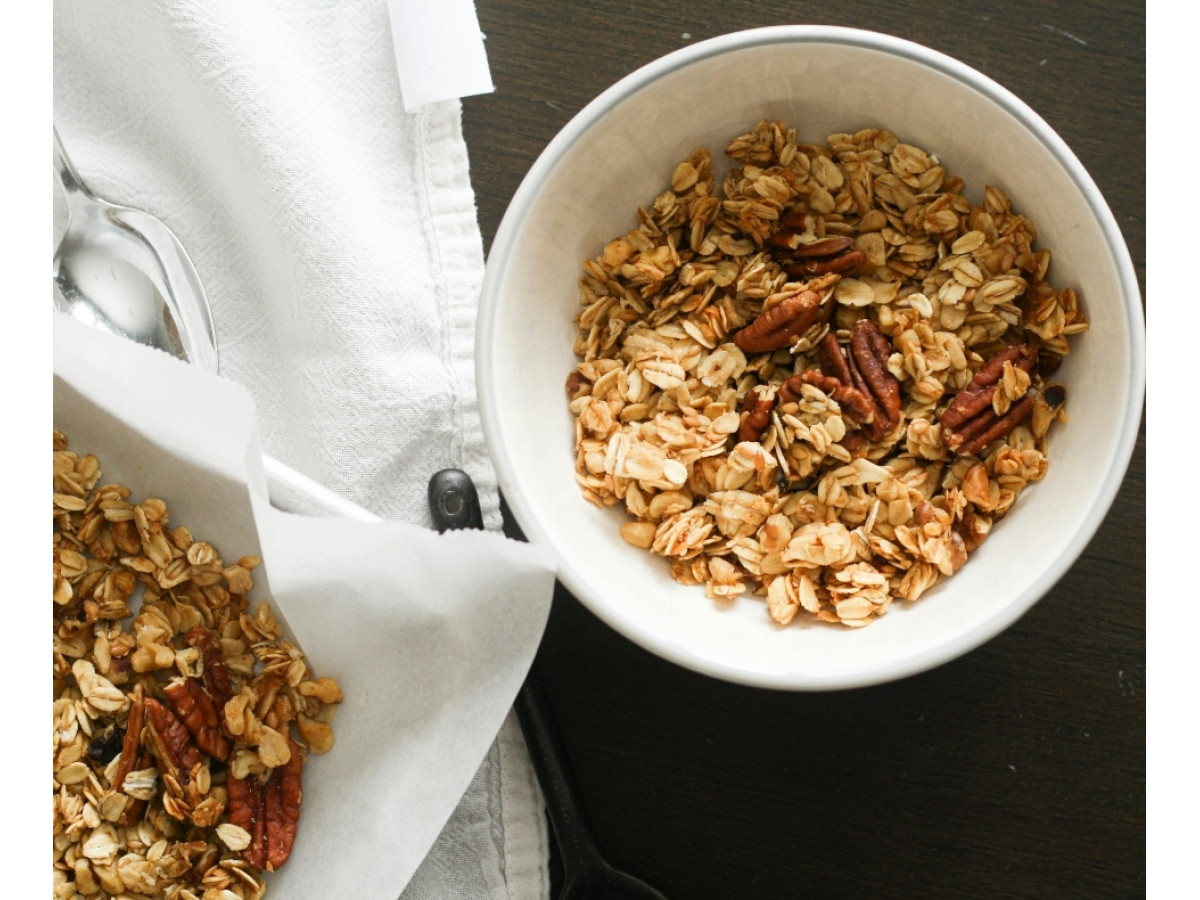
On granola packaging, you can often see labels such as “sugar-free” or “natural.” In practice, however, this does not always mean the product truly contains no sweet components. To understand what you are choosing, it is important to read the ingredient list, not just the large claims on the front of the package.
What Do They Mean by “Sugar”?
When people talk about sugar in products, they usually mean added white sugar. However, sweetness can also come from other ingredients. This is where confusion often arises.
Sugar-free granola does not always mean “not sweet.” It often means the absence of white sugar specifically, but not the complete absence of sweet ingredients.
Where Is Sweetness Most Often Hidden?
Even in sugar-free granola, sweetness can come from various ingredients. Most commonly, these include:
-
syrups (glucose, date syrup, agave syrup, corn syrup, etc.);
-
concentrated fruit juices;
-
honey;
-
dried fruits.
These ingredients are not “bad” in themselves. The issue arises when they become the base of the product rather than a small flavor addition.
The Difference Between Syrups: Why It Matters
Syrups differ not only in taste, but also in how quickly they affect blood glucose levels.
-
Glucose and corn syrups have a high glycemic index. They rapidly raise blood sugar levels and are often used as an inexpensive way to add sweetness and bind the product together.
-
Agave syrup has a lower glycemic index, but it remains a concentrated source of sugars and calories.
-
Date syrup contains micronutrients from dates, but it is still a form of added sugar, especially when used in large amounts.
In other words, there is a difference between syrups, but what matters more is not which syrup is used — it is how much is included and what role it plays in the product.
Fats in Granola
Another aspect that is often overlooked is the type of oil used in granola. It is needed for texture and baking, but the type matters.
-
High-quality vegetable oils (for example, sunflower oil or coconut oil in moderate amounts) are used for even baking.
-
Palm oil and hydrogenated fats are often added for technological and economic reasons. They make the product more stable and cheaper, but do not add nutritional value.
For a product intended to be part of a daily breakfast, the type of fat in the ingredient list is not a minor detail, but an important one.
Why It Is Important to Look at the Ingredient List
The ingredient list is always presented in descending order by quantity. This simple rule helps you quickly understand what forms the base of the product.
If a sweet component appears at the beginning of the list, it means it was not used just for light sweetening. In that case, the syrup or other sweet ingredient effectively becomes the foundation of the product rather than a complement — making it closer to a dessert than to a breakfast.
When sweet components appear closer to the end of the list, they usually play a secondary role: adding flavor without defining the nutritional value of the granola.
For a daily diet, options are generally more suitable when:
-
grains are the base;
-
sweet ingredients do not dominate;
-
flavor is formed by cocoa, nuts, and spices, not only by sweetness.
The main ingredient of granola is rolled oats (or a mix of different flakes), so this component should be listed first. Various nuts, dried fruits, seeds, and other additions may follow. Syrups and fats should ideally appear in the middle or toward the end of the list.
A Common Misconception About Granola
One of the most common mistakes is assuming that any granola is automatically healthy — or automatically unhealthy. In reality, granola is just a format.
The details make the difference: the ingredient list, the amount of sweet components, the type of fats, and the portion size. A mindful approach to choosing allows granola to become part of a daily diet rather than a random sweet snack.
Conclusion
Sugar-free granola is not a marketing trick and not a guarantee of health benefits — it is a matter of informed choice. It allows you to reduce the amount of added sweetness in your diet and make breakfast more balanced and predictable. The key lies in a transparent ingredient list and an understanding of what truly shapes the product’s flavor.
Write a comment