
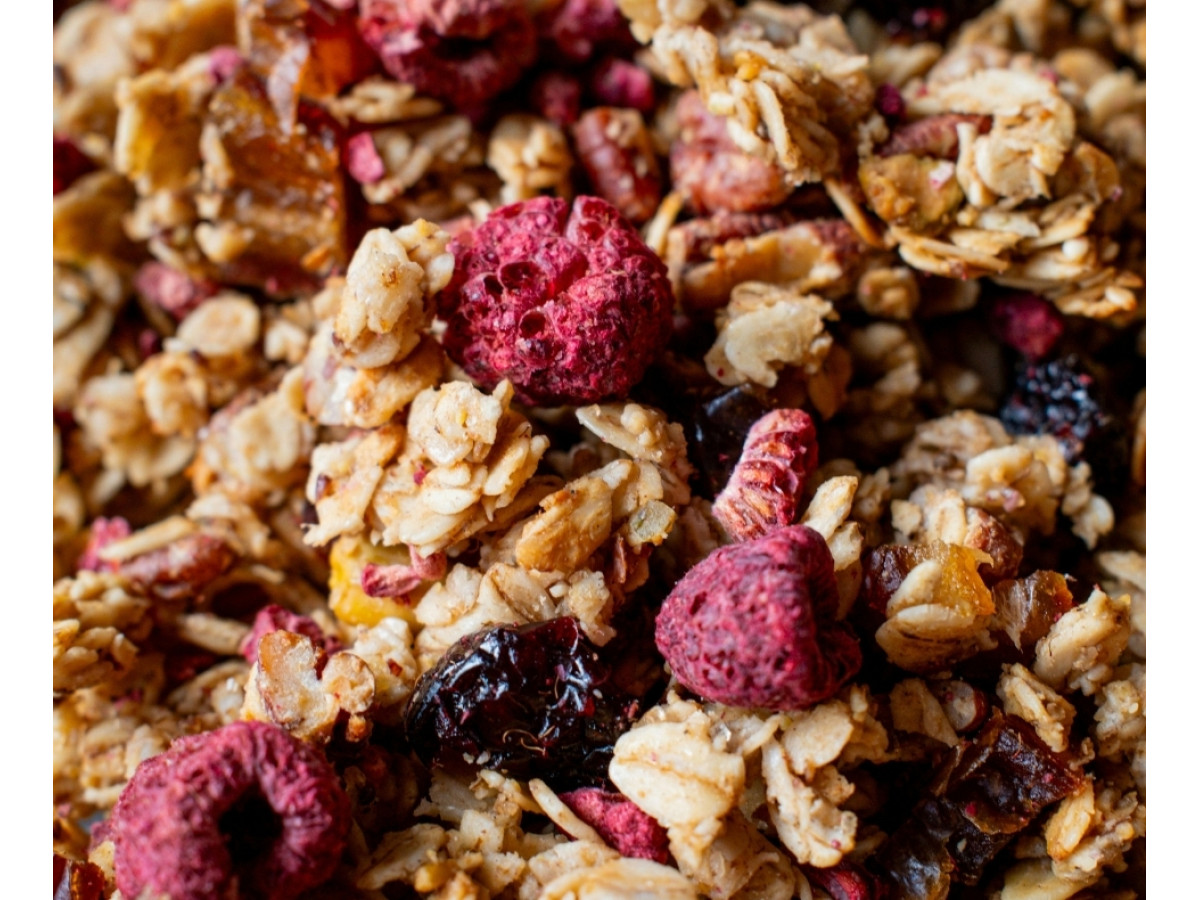
Granola has long become a familiar option for breakfast or a snack. At the same time, products with the same name can differ significantly in composition and nutritional value. That is why the question of how to choose granola is often more important than the format of the product itself.
Granola is not a separate quality standard, but a category. Its benefits and relevance in a daily diet depend on the ingredients it contains and the role it plays in overall nutrition.
Why Can Granola Differ in Nutritional Value?
One granola can serve as a convenient base for breakfast, while another may be closer to a sweet snack. The difference is determined not by names or positioning, but by the ratio of grains, sweet components, and fats. Therefore, when choosing, it is better to focus not on general claims, but on the ingredient list and your own needs.
What Should You Pay Attention to in the Ingredients?
1. The Base of the Product
In most cases, the base of granola is grains, most often rolled oats. They form the volume of the product, provide fiber, and influence the feeling of fullness.
If grains appear at the beginning of the ingredient list, this means they form the foundation of the product.
2. Sweet Components
Sweetness in granola can come from various ingredients: syrups, honey, concentrated juices, or dried fruits. What matters is not their presence itself, but their quantity and role in the overall formula.
When a sweet component appears among the first ingredients in the list, it effectively becomes one of the main components. In that case, the granola is closer in characteristics to a dessert than to a breakfast base.
3. Fats
Granola naturally contains fats from nuts and seeds. This is a normal and expected part of its nutritional value. Special attention should be paid to added fats used during baking, which should be checked in the ingredient list.
The type of fat matters, especially if granola is intended to be a regular part of the diet. Palm oil or hydrogenated fats are usually added for technological reasons and do not increase the nutritional value of the product.
4. Additional Ingredients
The length of the ingredient list alone is not an indicator of quality. The list may be quite extensive if the product contains various grains, nuts, seeds, spices, or fruits.
It is more important to pay attention to which ingredients are used and what function they serve. If most components are common food ingredients with a clear role, even a long list can be entirely appropriate. Questions arise when syrups or refined fats form the base of the product.
The Benefits of Granola in a Daily Diet
Granola can be a convenient element of nutrition when used consciously. It allows you to quickly assemble a breakfast, pairs easily with yogurt, milk, or fruit, and provides a longer-lasting feeling of fullness thanks to fiber and fats.
At the same time, granola is not a substitute for полноценous meals. It works best as part of an overall dietary structure rather than as a universal solution.
Common Mistakes When Choosing Granola
Mistake 1. Focusing Only on the Name or Packaging
Labels such as “healthy,” “fitness,” or “natural” do not provide objective information about the product. The most reliable guide remains the ingredient list.
Mistake 2. Ignoring Portion Size
Even high-quality granola can become too calorie-dense when consumed in excessive amounts. Portion size matters just as much as the ingredients.
Mistake 3. Dividing It Into “Healthy” and “Unhealthy”
Granola is not automatically healthy or unhealthy. Its suitability depends on how often and in what quantity it appears in your diet.
Conclusion
Choosing granola means evaluating its ingredients and aligning them with your needs. This approach allows the product to become part of a daily diet rather than a random sweet snack.
Granola can be a convenient alternative to traditional breakfast cereals when selected carefully and thoughtfully.
Write a comment